
Practical guide · Sources and transmission
Sources, testimony and interpretation: knowing what you can claim
An archive, a recollection and an AI response do not support a claim in the same way. The Guilhem Bélibaste case helps examine how an account connects to its sources, and what those sources leave unresolved.
Four categories that can overlap
- Source
- A document, recording, image or other inspectable trace. Ask who produced it, when, in what context and through which transformations it reached you. An identifiable source may still be incomplete or contested.
- Testimony
- An account attributed to a person, recorded at a particular time and in particular circumstances. Separate the event described from the time of telling. Preserve the wording and agreed conditions of use.
- Interpretation
- An argued reading of one or more traces, attributed to its author. Show the supporting passages, reasoning and possible alternatives. A study can also become a source for a different question.
- Reconstruction
- An account or scenario built from documented material and hypotheses. Identify imagined connections and gaps. A first-person generated voice does not become the authentic speech of the person portrayed.
Read the Bélibaste case without turning context into personal evidence
In the public screenshot about the papacy, the demonstrator distinguishes institutional chronology from documented personal contact. Its source panel presents contextual material and a synthesis requiring editorial checking. The displayed response should therefore be examined as a derived account, not direct testimony from Bélibaste.
This guide uses the presentation page and public screenshots, not access to the private demonstrator’s full corpus. It does not authenticate biographical claims in those screenshots or provide an independent historical audit.
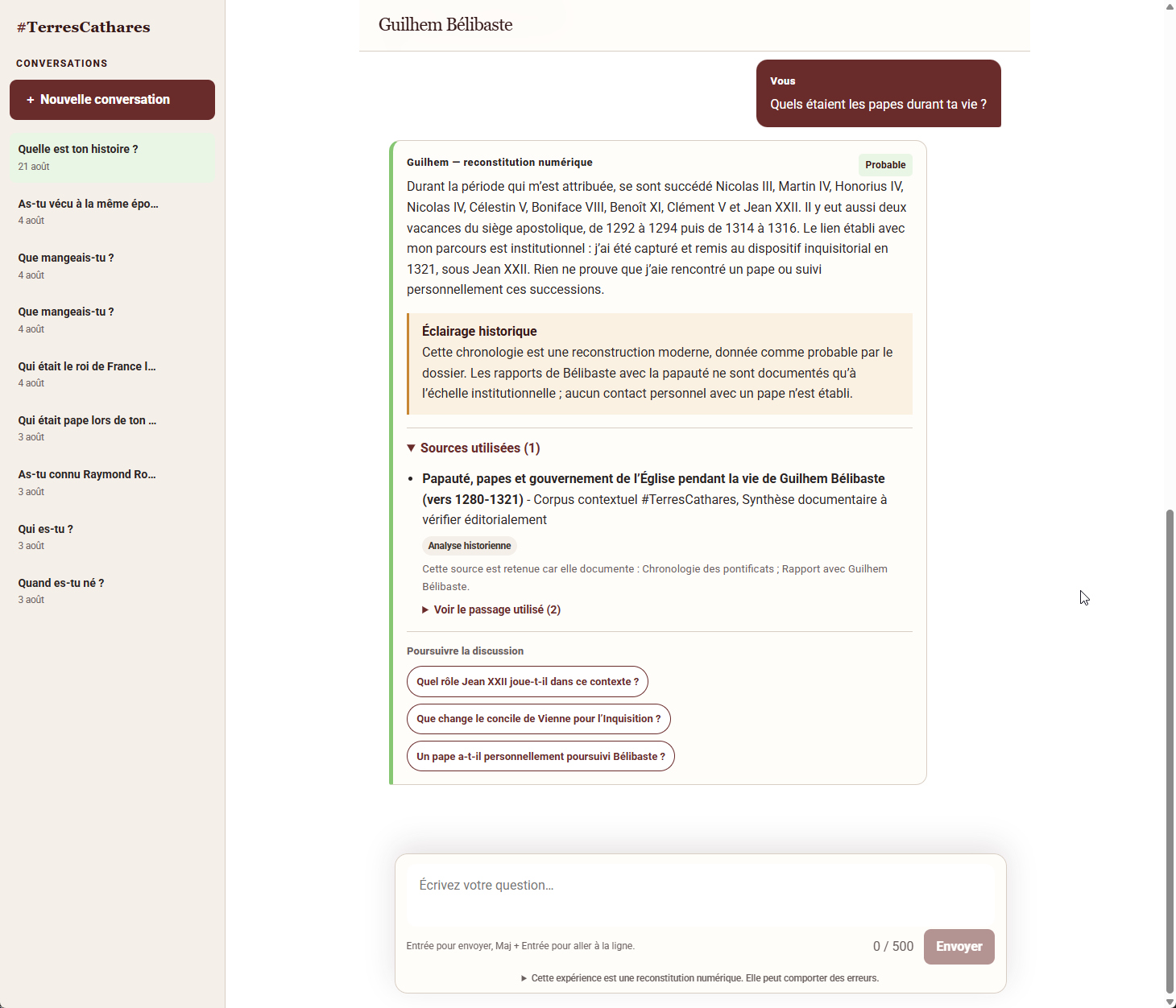
Three checks on the same screenshot
- First-person wording
- Reading a response using “I” does not establish that a historical person said it. Here, the digital account is explicitly a reconstruction.
- Context and relationships
- A list of officials or institutions contemporary with someone does not establish that they met. A cautious formulation is: the material examined does not establish this personal contact.
- Confidence and evidence
- The “probable” badge is a label displayed by the interface. It supplies no measured statistical probability and does not replace checking the cited passages.
Assess a claim in six steps
Ask a precise question
Write the claim to check rather than a broad topic. Separate the existence of an institution, personal contact and presumed intentions.
Identify the trace and provenance
Record reference, author, date, repository and version. Distinguish the original from its transcription, translation and derived synthesis.
Find the passage
Keep a page, paragraph or time marker. Read the surrounding material. If the passage is inaccessible, disclose that limit rather than imply you consulted it.
Attribute and qualify
Identify who is testifying or interpreting. State what is documented, reported, interpreted, hypothetical or unknown for this claim. A filename is not enough.
Preserve differences
Seek genuinely distinct support: two copies of the same text are not two independent confirmations. Contradiction and missing evidence should remain visible.
Set conditions and review
Check agreed access and sharing scope. Date the assessment, name its reviewer and explain what would cause you to revise the conclusion.
Record a voice without removing its context
For contemporary interviews, the Oral History Association’s principles emphasise the context of recollection, consent and access conditions. In your file, distinguish the recorded quotation, its transcription and your commentary. Oral History Association: core principles ↗
Provenance supports examination, not a truth certificate
W3C PROV describes entities, activities and people involved in producing information. This provenance framework can help document a chain of work. We do not present it as a truth label or certification of Mnemory products. W3C PROV: overview of the provenance framework ↗
A reusable assessment worksheet
Choose one claim, then record the trace examined, precise passage, attribution, unknowns and use conditions. Ask an authorised person to review it. This is a proposed method, not a standard or an additional Mnemory feature.
- Claim and question
- Trace type and reference
- Author, event date and collection date
- Passage, page or time marker
- Assigned status and reasoning
- Contradictions, gaps and other support
- Access, sharing and agreed conditions
- Reviewer, date and reason for revision
References and reading limits
Mnemory methodological guide prepared on 9 November 2026. These working categories do not replace examination of a document. The synthesis and screenshot remain separate from the historical sources they mention.
Frequently asked questions
Is testimony a source?
Yes, for a particular question. Attribute it and explain how it was produced; that does not automatically corroborate every claim it contains.
Are two documents enough to confirm a fact?
The count is not enough. Check whether they provide distinct support rather than copying the same account.
Does a sourced AI response guarantee truth?
No. A reference lets you inspect the support used; it may be misunderstood, incomplete or insufficient for the conclusion.